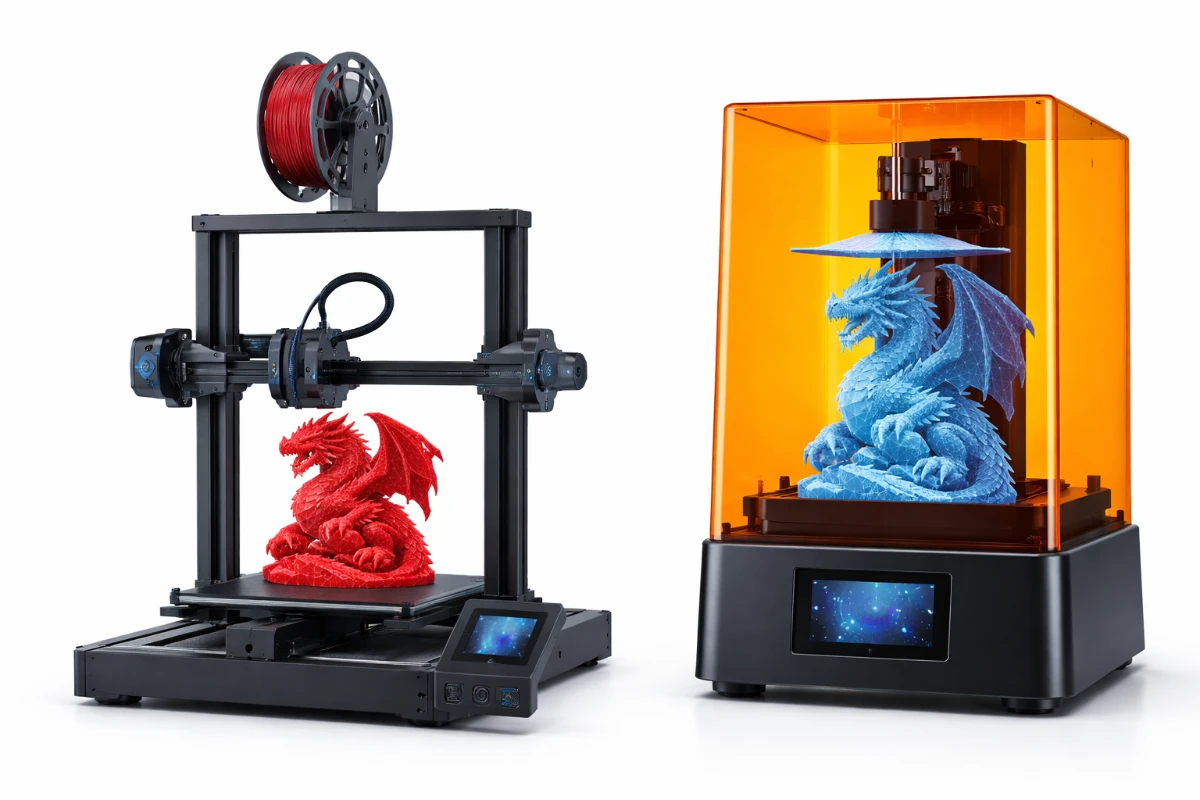
SLA and FDM are the two most popular 3D printing technologies available to consumers and professionals alike. Each uses a fundamentally different process to create objects, resulting in very different strengths and weaknesses. Understanding these differences is essential for choosing the right printer for your needs.
How FDM (Fused Deposition Modeling) Works
FDM printers work by melting thermoplastic filament and extruding it through a heated nozzle, depositing material layer by layer onto a build platform. The nozzle moves in X and Y axes while the bed moves in Z, building up the object from the bottom. FDM is the most common consumer 3D printing technology and the easiest to start with.
Common FDM Materials
- PLA – Most popular beginner material. Easy to print, biodegradable, low warp
- ABS – More heat-resistant, flexible, but prone to warping. Needs enclosure
- PETG – Combines PLA’s ease with ABS’s strength. Good for functional parts
- TPU – Flexible rubber-like material for phone cases, gaskets, toys
- ASA, Nylon, PC – Engineering-grade materials for demanding applications
How SLA (Stereolithography) Works
SLA printers use ultraviolet light to cure liquid photopolymer resin into solid layers. The build platform lifts up as each layer is cured from below (in MSLA/LCD printers) or traced by a laser (in traditional SLA). This allows extremely fine detail resolution — far beyond what FDM can achieve at any price point.
SLA Printer Variants
- Traditional SLA – Uses a UV laser, very accurate, used in industrial and dental applications
- MSLA/LCD – Uses an LCD screen to mask UV light, much more affordable, most consumer resin printers use this
- DLP – Uses a digital projector, fast and accurate, common in professional printers
SLA vs FDM – Detailed Comparison
- Print quality: SLA wins for surface detail and smoothness. FDM shows visible layer lines unless post-processed.
- Strength: FDM wins for structural strength. Resin parts can be brittle depending on the resin type.
- Materials: FDM uses filament (PLA, ABS, PETG, TPU, etc.); SLA uses resin — standard, ABS-like, flexible, dental, castable
- Cost to buy: Both are very affordable now. Good FDM starts at $200; good resin starts at $150
- Running cost: FDM filament (~$20/kg) is cheaper than resin (~$30–50/L)
- Post-processing: FDM just needs support removal. SLA requires washing in IPA and UV curing
- Safety: Resin is toxic — requires gloves, ventilation, and safe disposal. FDM is much safer for home use
- Best for: FDM = large functional parts, prototypes, beginners. SLA = miniatures, jewelry, dental, high-detail decorative models
Which Should You Choose?
Choose FDM if you want an easy, versatile machine for everyday printing with a wide range of materials. Choose SLA if you need exceptional detail for small, precise objects and are willing to handle the additional post-processing workflow.
Many serious makers own both — FDM for large prints and prototypes, SLA for detailed figurines and precision parts.
Read our guides on choosing the right 3D printer for your specific needs and budget.